



Introduction
Search engine optimization (SEO) is generally divided into three major areas: on-page SEO, technical SEO, and off-page SEO. While on-page SEO focuses on optimizing elements within a website, off-page SEO focuses on activities and signals that occur outside the website.
Off-page SEO plays an important role in building a website’s authority, credibility, reputation, and visibility. It can help search engines understand how a website is perceived across the wider web.
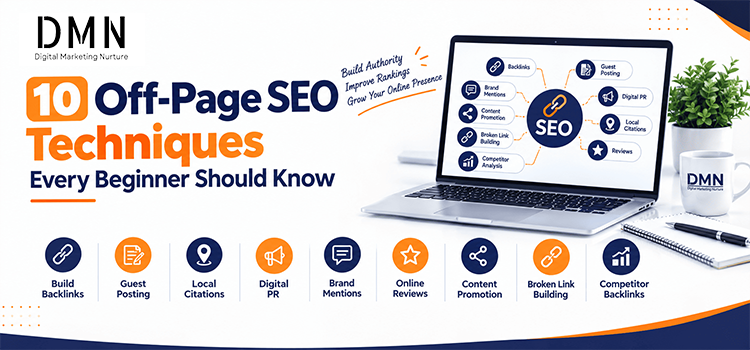
For beginners, off-page SEO is often associated only with backlinks. However, modern off-page SEO involves much more than link building. It can include digital PR, brand mentions, local citations, reviews, content promotion, and relationship building.
In this guide, we’ll explore 10 important off-page SEO techniques that beginners should understand.
What Is Off-Page SEO?
Off-page SEO refers to activities performed outside a website to improve its visibility, authority, reputation, and potential to rank in search engine results.
Some common examples include:
- Building relevant backlinks
- Guest posting
- Digital PR
- Local citations
- Online reviews
- Brand mentions
- Content promotion
- Broken link building
- Community engagement
The main objective is to establish signals that demonstrate that a website is relevant, trustworthy, useful, and recognized within its subject area.
1. Build High-Quality Backlinks
A backlink is a hyperlink from one website to another.
For example, if Website A publishes an article and links to a useful resource on Website B, Website B receives a backlink.
Backlinks can help search engines discover pages and understand relationships between websites. Links from relevant and trustworthy websites can be particularly valuable.
What makes a backlink valuable?
Consider factors such as:
- Relevance of the linking website
- Quality of the linking page
- Context surrounding the link
- Whether the link is editorially earned
- Overall trustworthiness of the source
The main objective is to establish signals that demonstrate that a website is relevant, trustworthy, useful, and recognized within its subject area.
2. Guest Posting
Guest posting involves creating an article for another website or publication.
For example, an SEO professional could contribute an educational article about technical SEO to a marketing publication.
Guest posting can provide opportunities to:
- Reach a new audience
- Demonstrate expertise
- Build professional relationships
- Generate referral traffic
- Earn relevant links when appropriate
However, guest posting should primarily be about providing useful content to the publication’s audience rather than creating links solely for ranking purposes.
Best Practice
Choose websites that are:
- Relevant to your subject
- Credible
- Useful to your target audience
- Selective about the content they publish
Avoid mass-producing low-quality guest posts simply to obtain backlinks.
3. Local Citations
Local citations are online references to a business’s information.
They commonly contain details such as:
- Business name
- Address
- Phone number
- Website
- Business category
Citations can appear on:
- Business directories
- Local directories
- Industry websites
- Chamber of commerce websites
- Local publications
For businesses targeting specific geographic areas, maintaining accurate and consistent business information across important platforms can support local search visibility.
Example
A restaurant in Delhi might have its business information listed on relevant local and industry directories. Consistent information helps users and search engines understand the business.
4. Digital PR
Digital PR involves using online public relations strategies to generate awareness, coverage, mentions, and references for a website or brand.
Instead of directly asking websites for links, digital PR focuses on creating something that journalists, publishers, bloggers, or industry professionals may find interesting enough to discuss.
Examples include:
- Original research
- Industry surveys
- Data studies
- Expert commentary
- Newsworthy announcements
- Industry reports
- Interesting statistics
- Unique case studies
Example
A company could conduct a survey of 1,000 consumers and publish the findings. Other websites may reference the research in their own articles.
This can result in brand exposure, referral traffic, and potentially earned backlinks.
5. Build Brand Mentions
A brand mention occurs when another website, publication, social platform, or online resource refers to a brand.
Not every brand mention contains a link.
Example
“Company X recently published a report about e-commerce trends.”
This is a brand mention even if Company X’s website isn’t linked.
Monitoring brand mentions can help businesses understand how they are being discussed online.
When an unlinked mention appears on a relevant website, the website owner may sometimes be open to adding a link to the referenced source.
However, outreach should be relevant and useful rather than aggressive or repetitive.
6. Encourage Genuine Online Reviews
Online reviews can contribute to a business’s overall reputation and can be particularly important for local businesses.
People often use reviews when deciding whether to:
- Visit a business
- Purchase a product
- Hire a service provider
- Try a restaurant
- Enroll in a course
- Use a professional service
Businesses can encourage genuine customers to share their experiences on appropriate review platforms.
Avoid Fake Reviews
Businesses should not create fake reviews or manipulate ratings.
A sustainable online reputation is built through:
Good service → Genuine customer experience → Authentic reviews → Stronger reputation
Reviews should reflect real experiences rather than artificially created feedback.
7. Promote Valuable Content
Creating excellent content is only one part of content marketing. People also need to discover it.
Content promotion can involve:
- Social media
- Email newsletters
- Industry communities
- Online publications
- Professional networks
- Content partnerships
For example, after publishing a comprehensive guide about keyword research, you could promote it through relevant professional communities and social platforms.
Greater visibility can lead to:
Content discovery → More readers → More shares → More brand awareness → Potential mentions and links
Social media activity itself should not be treated as a simple substitute for backlinks. Its major value is often in distribution, visibility, audience building, and content discovery.
8. Broken Link Building
Broken link building is a technique that involves finding outdated or non-working links on relevant websites and suggesting a useful replacement.
How it works
Suppose a website has an article about content marketing containing a link to an old resource that no longer exists.
You have already published a comprehensive and relevant guide covering the same topic.
You can contact the website owner and explain that the existing link is no longer working, then suggest your resource as a possible replacement.
Basic Process:
Find broken link → Check relevance → Have useful replacement content → Contact website owner
The suggested content should genuinely help the website’s visitors.
9. Analyze Competitor Backlinks
Competitor backlink analysis is the process of examining the websites that link to competing websites.
This can help identify potential opportunities for your own SEO strategy.
You can investigate:
- Referring domains
- Linking pages
- Types of content receiving links
- Industry publications
- Resource pages
- Guest-post opportunities
- Local websites
- Digital PR opportunities
Example
Suppose three competitors in the same industry are receiving links from a particular industry publication.
That publication may be worth researching to determine whether it accepts relevant contributions or resources.
Competitor analysis should be used for research and opportunity discovery, not for blindly copying another website’s backlink profile.
10. Build Relationships Within Your Industry
SEO doesn’t happen in isolation.
Building genuine relationships with:
- Industry professionals
- Publishers
- Journalists
- Bloggers
- Researchers
- Businesses
- Content creators
- Professional communities
can create opportunities for collaboration and visibility.
Relationships may lead to:
- Interviews
- Expert quotes
- Podcast appearances
- Collaborative content
- Industry articles
- Research partnerships
- Event participation
- Natural mentions
The strongest off-page strategies often come from creating something useful and becoming a recognized source within a particular subject area.
Off-Page SEO vs On-Page SEO
Understanding the difference between on-page and off-page SEO is important.
|
On-Page SEO
|
Off-Page SEO
|
|---|---|
|
Optimizing page titles
|
Earning backlinks
|
|
Meta descriptions
|
Digital PR
|
|
Content optimization
|
Brand mentions
|
|
Internal linking
|
Guest Contributions
|
|
Heading structure
|
Local citations
|
|
Image optimization
|
Online reputation
|
|
Keyword optimization
|
Content promotion
|
|
URL structure
|
Industry relationships
|
Both areas work together.
A website with strong off-page signals but poor content and technical problems may still struggle to perform well.
Similarly, an excellent website may benefit from greater visibility and authority through effective off-page activities
Off-Page SEO vs On-Page SEO
Use this checklist when developing your first off-page SEO strategy:
- Create useful and original content
- Research relevant websites
- Analyze competitor backlinks
- Identify relevant citation opportunities
- Promote important content
- Monitor brand mentions
- Encourage genuine customer reviews
- Research broken-link opportunities
- Research broken-link opportunities
- Build relationships within your industry
- Monitor your backlink profile
- Review referral traffic
- Avoid manipulative link-building practices
Frequently Asked Questions
Off-page SEO refers to activities and external signals that can influence a website's visibility, authority, reputation, and search performance outside the website itself.
Backlinks can remain an important part of SEO, but quality and relevance are more meaningful than simply acquiring a large number of links.
Beginners can start with content promotion, competitor research, local citations where relevant, genuine reviews, and building relationships within their industry.
Social media can support off-page SEO by increasing content visibility, brand awareness, audience engagement, and opportunities for content discovery. Social activity should not be viewed simply as a direct ranking-factor replacement for links.
There is no ideal number of backlinks that applies to every website. The appropriate backlink profile depends on the website, industry, competition, content, and overall SEO environment
Links associated with manipulative or spammy practices can create SEO risks. A better approach is to focus on earning relevant, natural, and useful references.
The importance and type of off-page SEO can vary by website and industry. Websites competing for highly competitive search queries may benefit significantly from strong authority and reputation signals, while the exact strategy should depend on the site's goals and audience.
Final Thoughts
Off-page SEO is much broader than simply building backlinks.
A successful strategy combines quality content, relevant links, brand visibility, digital PR, genuine reviews, local presence, industry relationships, and a strong online reputation.
For beginners, the best approach is to start with fundamentals rather than chasing shortcuts. Create resources worth referencing, build genuine relationships, promote useful content, and consistently monitor your website’s external presence.
Over time, these activities can contribute to a stronger and more credible online presence.
Want to learn SEO practically? Understanding off-page SEO is one part of developing complete SEO skills. Practical learning should also cover keyword research, on-page SEO, technical SEO, local SEO, analytics, content strategy, and SEO tools.