

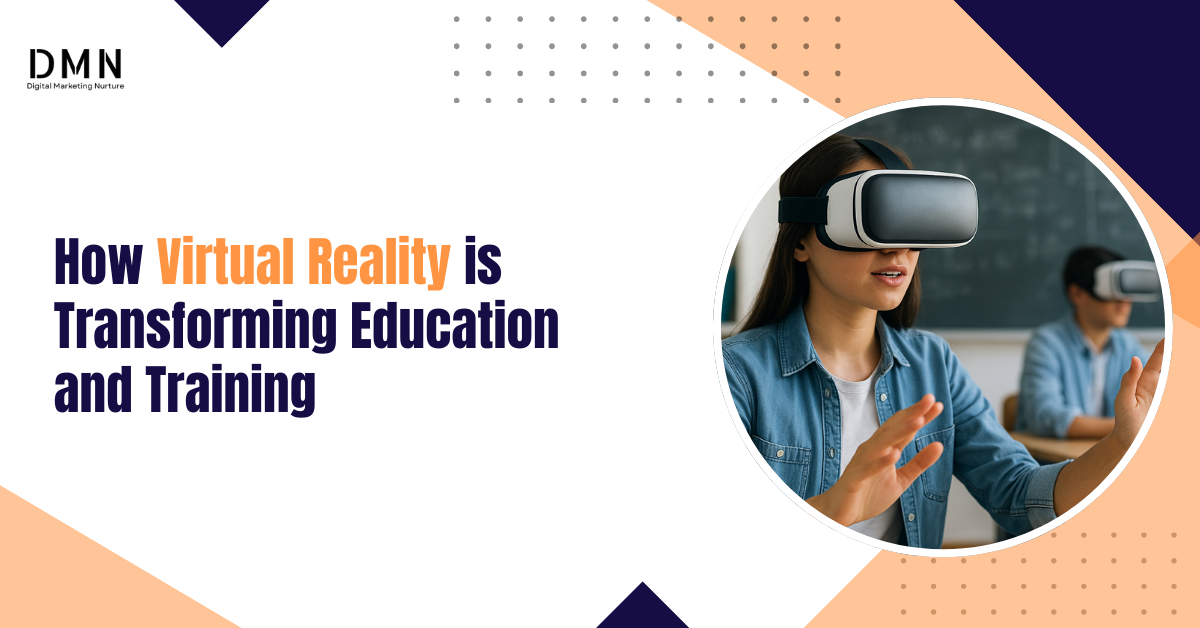
How Virtual Reality is Transforming Education and Training — Breaking Limits and Empowering Future Learning
Virtual Reality is no longer just a futuristic concept — it’s a technology that’s actively reshaping how we learn, train, and experience information. From classrooms to corporate environments, Virtual Reality (VR) has become a bridge between theory and practice, allowing learners to step into fully immersive environments that bring concepts to life.
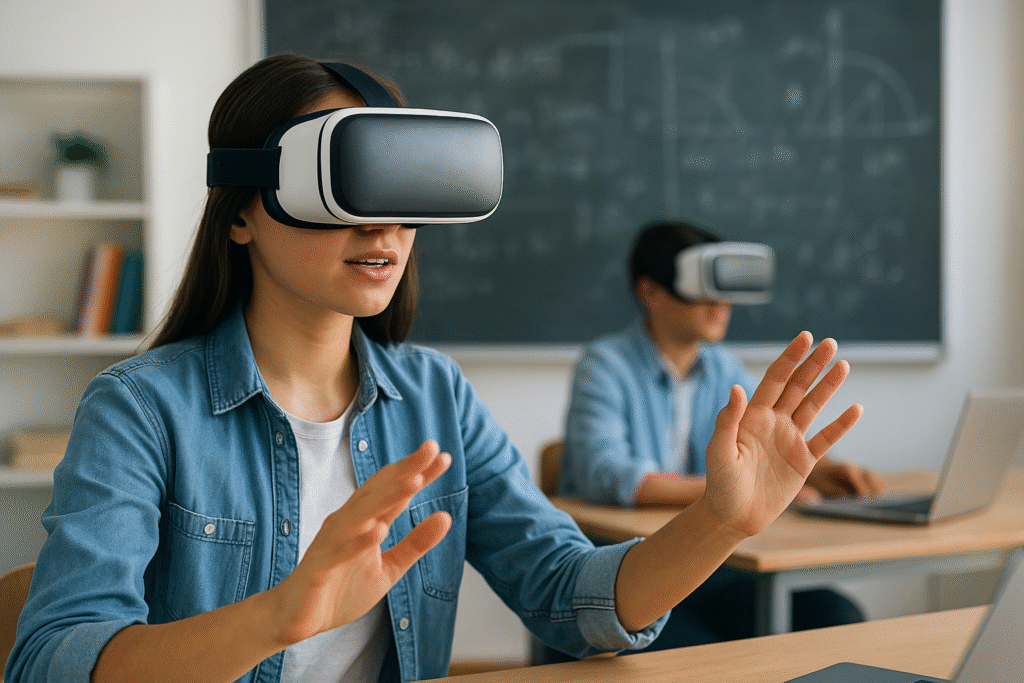
Traditional learning methods often rely on textbooks, videos, and classroom lectures — but Virtual Reality in education takes things a step further. It lets learners experience situations rather than simply reading about them. Imagine a student walking through ancient Rome, a medical trainee practicing surgery in a safe virtual lab, or an employee mastering complex machinery without any risk — that’s the power of Virtual Reality.
What is Virtual Reality and How Does It Work?
VR relies on a combination of:
- Head-Mounted Displays (HMDs) like Oculus Quest
- Motion Sensors and Controllers to track hand movements
- 360° Videos or Simulated 3D Models for realistic visualization
In education and training, these components come together to create interactive lessons where learners can practice skills, explore new worlds, or visualize abstract concepts in real-time.
Why Virtual Reality is a Game-Changer in Education
Virtual Reality introduces an entirely new dimension to learning. It’s not just about replacing physical classrooms — it’s about enhancing them.
a. Learning by Doing
Research shows that people retain up to 75% more information when learning through experience rather than reading or watching. With VR, learners can do instead of just observe.
Example: A biology student can explore the human body from the inside or observe the beating of a 3D heart model in real time.
b. Breaking Geographical Barriers
Virtual Reality makes distance irrelevant. Students from different parts of the world can share a virtual classroom and collaborate on projects as if they were sitting together.
c. Safe Practice for Risky Situations
Whether it’s a pilot training for emergency landings or a firefighter learning how to navigate burning buildings, VR training environments allow practice without any real-world danger.
Applications of Virtual Reality in Education
Let’s explore how Virtual Reality is being used in different educational settings:
a. Classroom Learning
Teachers are using VR to make lessons more interactive and memorable.
- History: Explore ancient civilizations or historical battles.
- Science: Conduct virtual experiments safely.
- Geography: Travel virtually to distant countries and landscapes.
b. Special Education
Virtual Reality offers tailored experiences for students with learning disabilities. It helps improve focus, emotional understanding, and sensory learning through visual and interactive engagement.
c. Higher Education and Research
Universities are integrating Virtual Reality labs for research and simulations. For instance, architecture students can walk through their designs before construction begins.
d. Language Learning
Instead of memorizing vocabulary, learners can virtually “travel” to different countries and practice real-life conversations with simulated characters.
Virtual Reality in Professional Training
Beyond education, Virtual Reality training has become a powerful tool for companies and industries worldwide. It helps employees learn skills faster, safer, and more effectively.
a. Healthcare Training
VR allows medical professionals to perform complex surgeries virtually before handling real patients. It builds confidence and accuracy.
Example: Surgeons can practice robotic-assisted surgery techniques in a virtual environment with real-time feedback.
b. Corporate and Soft Skills Training
Companies use VR for onboarding, leadership training, and even customer service simulations. Employees can learn communication skills or handle workplace challenges in realistic scenarios.
c. Industrial and Technical Training
VR helps mechanics, engineers, and factory workers learn how to operate machinery without the risk of damage or injury.
| Traditional Training | VR Training | |
|---|---|---|
|
Time |
Longer sessions; limited retention |
Longer sessions; limited retention |
|
Cost |
Recurring expenses for venues, travel, and materials |
Higher initial setup cost but lower long-term expenses |
|
Engagement |
Passive and less interactive |
Highly engaging and hands-on learning |
|
Safety |
Risk in practical training environments |
100% safe, risk-free simulations |
Benefits of Virtual Reality in Education and Training
The adoption of VR brings several measurable benefits:
a. Higher Engagement
Learning becomes exciting and interactive, keeping students focused longer.
b. Improved Retention
Learning becomes exciting and interactive, keeping students focused longer.
c. Cost-Effective in the Long Run
While VR setup costs might seem high initially, it reduces expenses on travel, physical equipment, and instructor time.
Real-World Examples of Virtual Reality in Action
- Google Expeditions: Lets students take virtual field trips to landmarks like the Great Wall of China or the solar system.
- zSpace: Offers VR-based STEM learning tools for interactive 3D experiences.
- Osso VR: Used by surgeons for hands-on training in complex medical procedures.
- STRIVR: A leading VR training platform for corporations like Walmart and Verizon to train employees in realistic simulations.
Challenges of Implementing Virtual Reality in Education
Even though the benefits are clear, there are some challenges institutions and organizations must address:
- High Initial Costs: Headsets and software can be expensive.
- Technical Expertise: Educators need proper training to use VR effectively.
- Content Creation: Developing quality VR content requires time and resources.
- Physical Discomfort: Some users experience motion sickness or eye strain.
These real-world examples prove that Virtual Reality in education and training isn’t just a trend — it’s the future of learning.
The Future of Virtual Reality in Learning
The future looks promising. As Virtual Reality technology evolves, we can expect even more immersive, AI-driven, and personalized learning environments. Integration with Augmented Reality (AR) and Artificial Intelligence (AI) will further enhance how we learn, visualize, and apply knowledge.
Soon, students may attend entire virtual universities, and employees may train in metaverse-like workspaces that simulate every possible scenario.
Ready to Experience the Future of Learning? Step into the World of Virtual Reality and Transform the Way You Learn, Teach, and Grow!
Conclusion: Transforming Learning, One Experience at a Time
Virtual Reality is transforming the education and training landscape from static learning to active participation. It brings abstract concepts to life, enables safe practice, enhances memory, and opens global access to high-quality learning experiences.
Whether you’re a student, teacher, or business professional, Virtual Reality holds the key to faster learning, better engagement, and limitless possibilities.