
How Autonomous AI Agents Work:
Artificial Intelligence has evolved rapidly over the past few years. While traditional AI systems primarily respond to user prompts, a new paradigm known as Agentic AI is transforming how machines operate. Instead of simply generating answers, Agentic AI systems can plan, reason, make decisions, and execute tasks autonomously to achieve specific goals. From customer service automation to software development and business operations, autonomous AI agents are becoming the foundation of next-generation digital workforces. In this guide, we’ll explore what Agentic AI is, how it works, its core components, use cases, benefits, challenges, and why it’s considered the future of intelligent automation.

What Is Agentic AI?
Agentic AI refers to artificial intelligence systems designed to act independently toward achieving defined objectives. Unlike traditional AI models that wait for instructions at every step, agentic systems can:
- Understand goals
- Create action plans
- Make decisions
- Use tools and resources
- Adapt to changing conditions
- Learn from outcomes
Think of traditional AI as an assistant that answers questions, while Agentic AI functions more like a capable employee who can independently complete tasks from start to finish.
How Agentic AI Differs from Generative AI?
Many people confuse Agentic AI with Generative AI, but they serve different purposes.
| Generative AI | Agentic AI |
|---|---|
|
Creates content |
Takes action |
|
Responds to prompts |
Pursues goals |
|
Single interaction |
Multi-step workflows |
|
Limited memory |
Persistent context |
|
Human-driven |
Semi-autonomous or autonomous |
The Core Components of Agentic AI
- Goal Understanding:Every agent starts with an objective. Examples include:
- Schedule meetings
- Resolve customer inquiries
- Generate business reports
- Optimize inventory management
- Build software applications
The agent interprets the goal and converts it into actionable tasks.
- Planning Engine:Once a goal is understood, the agent creates a strategy. For example, if asked to “generate a competitor analysis report,” the agent may:
- Identify competitors
- Collect market data
- Analyze findings
- Create visualizations
- Compile a final report
This planning capability allows AI agents to solve complex problems without constant human supervision.
- Memory System:Memory enables agents to retain context across interactions. There are generally two types: Short-Term Memory Stores information relevant to the current task. Example:
- Current conversation
- Active project details Long-Term Memory Stores historical knowledge and past experiences.
Example:
- Customer preferences
- Previous project outcomes
- Organizational policies
Memory makes Agentic AI more effective and personalized over time.
- Tool Usage:Modern AI agents can interact with external systems and tools. Examples include:
- Databases
- CRM platforms
- Search engines
- APIs
- Email systems
- Analytics platforms
- Project management software
Instead of simply suggesting actions, the agent can perform them directly. For instance, an AI sales agent could:
- Retrieve customer data
- Draft an email
- Send follow-ups
- Update CRM records
- Generate sales reports
All without human intervention.
- Decision-Making and Reasoning Autonomous agents continuously evaluate their progress. They ask questions such as:
- Am I moving toward the goal?
- Is there a better approach?
- Did this action succeed?
- Should I revise my plan?
This reasoning layer allows agents to adapt dynamically when circumstances change.
How Autonomous AI Agents Work?
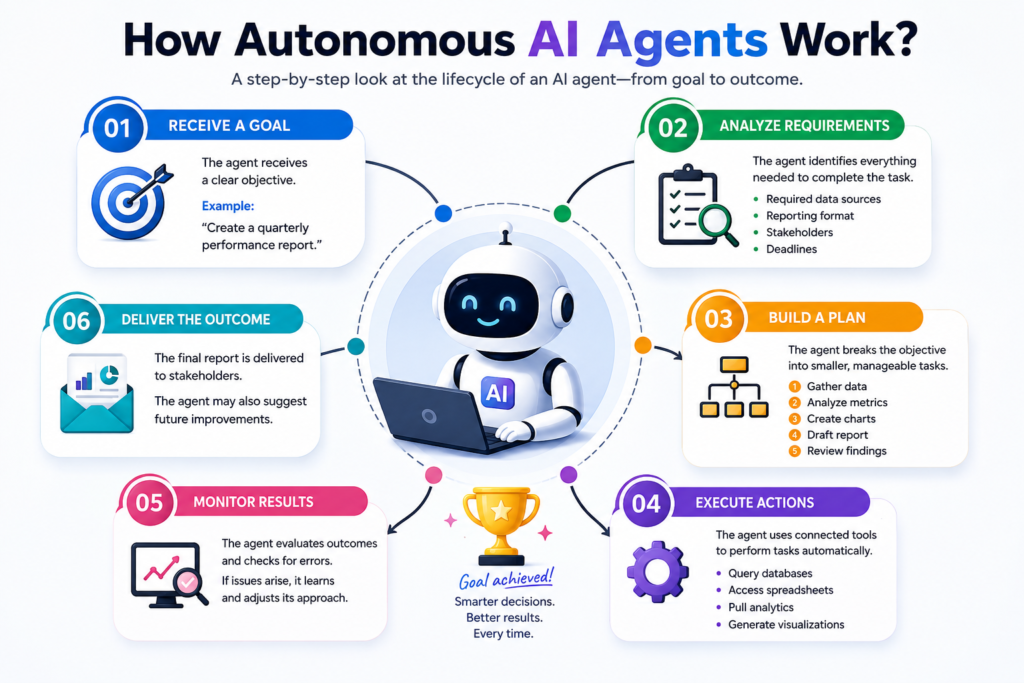
The lifecycle of an AI agent generally follows this workflow:
Step 1: Receive a Goal
Example: “Create a quarterly performance report.”
Step 2: Analyze Requirements
The agent identifies:
- Required data sources
- Reporting format
- Stakeholders
- Deadlines
Step 3: Build a Plan
The system breaks the objective into smaller tasks:
- Gather data
- Analyze metrics
- Create charts
- Draft report
- Review findings
Step 4: Execute Actions
The agent uses connected tools to perform tasks automatically.
Examples:
- Query databases
- Access spreadsheets
- Pull analytics
- Generate visualizations
Step 5: Monitor Results
The agent evaluates outcomes and checks for errors. If problems arise, it adjusts its approach.
Step 6: Deliver the Outcome
The final report is presented to stakeholders. The agent may also suggest future improvements.
Real-World Applications of Agentic AI :
Customer Support
AI agents can:
- Resolve common inquiries
- Escalate complex cases
- Update customer records
- Follow up automatically
Benefits include faster response times and reduced support costs.
Software Development
Agentic AI can:
- Write code
- Run tests
- Detect bugs
- Deploy applications
- Monitor performance
Development teams gain significant productivity improvements.
Marketing Automation
Marketing agents can:
- Conduct market research
- Generate content
- Manage campaigns
- Analyze performance
- Recommend optimizations
This enables highly scalable marketing operations.
Financial Services
AI agents can:
- Monitor transactions
- Detect anomalies
- Generate reports
- Conduct risk assessments
Organizations gain better visibility and operational efficiency.
Supply Chain Management
Autonomous agents can:
- Forecast demand
- Track inventory
- Optimize logistics
- Reduce waste
- Improve fulfillment
This leads to smarter resource allocation and cost savings.
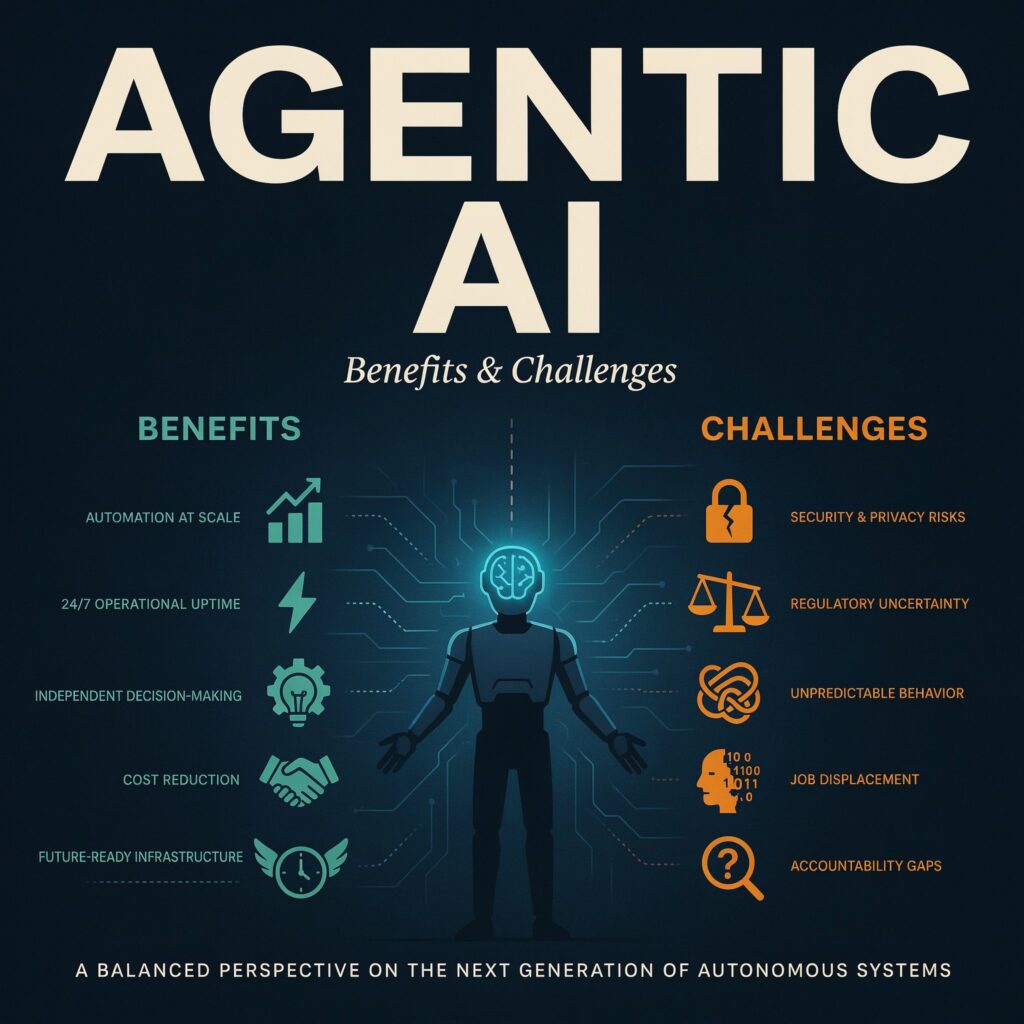
Benefits of Agentic AI :
Increased Productivity
AI agents can work continuously without fatigue, handling repetitive and complex tasks simultaneously.
Faster Decision-Making
Real-time data analysis enables quicker and more informed decisions.
Reduced Operational Costs
Automation reduces manual workloads and improves efficiency.
Scalability
Organizations can deploy multiple AI agents across departments without significantly increasing headcount.
Improved Accuracy
Agents can consistently follow predefined processes and reduce human error.
Challenges and Risks of Agentic AI :
While promising, Agentic AI introduces several challenges.
Governance and Control
Organizations need mechanisms to ensure agents remain aligned with business objectives.
Security Risks
Autonomous systems often access sensitive data and critical systems. Strong security controls are essential.
Hallucinations and Errors
AI models can still generate incorrect outputs or make flawed decisions. Human oversight remains important.
Ethical Concerns
Questions around accountability, transparency, and bias must be addressed before widespread adoption.
Regulatory Compliance
Businesses must ensure AI agents comply with industry regulations and data protection laws.
The Future of Agentic AI
The next wave of AI innovation is moving beyond simple chat interactions toward fully autonomous digital workers.
Future AI agents will likely:
- Collaborate with other agents
- Manage entire business workflows
- Learn continuously from experience
- Operate across multiple platforms
- Handle increasingly complex decision-making tasks
As organizations seek greater efficiency and scalability, Agentic AI is expected to become a core component of enterprise technology strategies.
Companies that adopt autonomous AI agents effectively will be better positioned to innovate, reduce costs, and create competitive advantages in an increasingly AI-driven world.
Conclusion
Agentic AI represents a significant evolution in artificial intelligence. Unlike traditional systems that simply generate responses, autonomous AI agents can understand goals, create plans, make decisions, use tools, and execute tasks with minimal human intervention.
By combining reasoning, memory, planning, and action, Agentic AI is enabling businesses to automate complex workflows and unlock new levels of productivity. While challenges around governance, security, and ethics remain, the potential benefits are substantial.
As AI continues to advance, Agentic AI is poised to become the foundation of the next generation of intelligent automation.
FAQs
What is Agentic AI?
Agentic AI refers to autonomous AI systems capable of planning, reasoning, and taking actions to achieve goals with minimal human supervision.
How is Agentic AI different from Generative AI?
Generative AI creates content, while Agentic AI can execute multi-step tasks and make decisions to achieve outcomes.
What are AI agents?
AI agents are software systems that perceive information, make decisions, use tools, and perform actions to accomplish specific objectives.
What industries can benefit from Agentic AI?
Industries including healthcare, finance, customer service, manufacturing, software development, logistics, and marketing can benefit significantly from Agentic AI.
Is Agentic AI the future of automation?
Many experts believe Agentic AI will drive the next generation of intelligent automation by enabling systems to operate more independently and efficiently.